
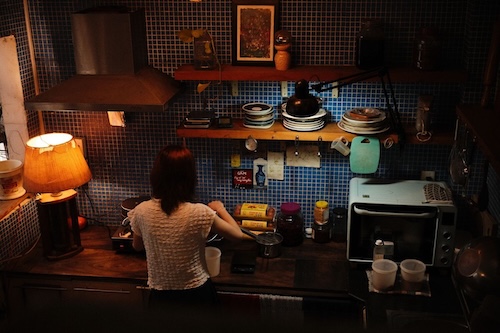
Fishya Setiana’s Orange Chicken / Multiverse, published in the Summer 2026 Issue, explores and nurtures the complexity of mother-daughter relationships. Using a contrapuntal structure, Setiana reflects on the notion of the ‘multiverse’, a multiverse which holds different possibilities for the poem’s subject, the mother, or ‘Ma’, all recounted from the perspective of the daughter.
At the surface, this poem is about motherhood and its self-sacrificing nature. There is no doubt that the mother loves the daughter, because those are the people we sacrifice for – the ones we love. Nevertheless, the mother’s dreams of being a “movie star, millionaire, tax attorney, sales associate” are surrendered so that her hands are free to cook the titular orange chicken. The orange chicken, wok and endearment ‘Ma’, suggest that the subject of this poem is not only a mother, but an Asian-American mother. At this moment, Setiana’s work becomes about more than just the sacrifices of a tired suburban housewife; it is also explored through the lens of multiculturalism.
This facet is key, because not only do we have the already disjointed image of woman and mother, but we now have the added tension among woman / mother / culture, and the multitudes that exist within these identities. In her Wired article, ‘A Letter to My Fellow Asian Mothers From the Multiverse’, Adrienne So writes, “to be an immigrant woman means to hold many visions of yourself in your head at once”. When So singles out the “immigrant woman”, she, like Setiana, is discussing the struggle between female self-identity and multiculturalism. She also is drawing on the idea of having many visions of yourself and recognising all the different possibilities you could have been. So, why is multiculturalism such a tool for making women reflect on their identities as mothers? Because motherhood is not a biological fact, but a cultural construct.
Motherhood is disruptive to a woman’s sense of self, because it has, over time, become intrinsically tied to who we are as people. What we believe about motherhood has been cultivated by centuries of reinforced social norms and behaviours. By addressing multiculturalism in a poem about womanhood and its possibilities, Setiana is calling out how trying to co-exist amongst different cultures and their traditional beliefs can confuse a woman’s sense of self. Different cultures hold different beliefs about what womanhood, and specifically motherhood, looks like, leaving immigrant and multi-cultural women left to imagine all the different, fragmented versions of self that exist out there in the realm of possibilities.
Hands are so important in demonstrating the different halves of the poem. What they make, what they do, and the evocation of nurturing. The hands in (Orange Chicken) are tethered to domesticity: covered in grease, tossing a wok, wrapped in tape and grime, shoving money into pillowcases. Ma’s hands in this poem are confined to the kitchen, to motherhood, to cooking. The hands are busy creating the orange chicken dish, which is saturated with those themes of multiculturalism, immigration and assimilation. The hands in the (Multiverse) however, are “touch[ing] the whole sky”, “getting [a] diploma”, and “reach[ing] for the surface of the sun”. The hands in Orange Chicken / Multiverse are writing the poem, nurturing an image of a multi-faceted woman who is both a symbol of domesticity and a woman with dreams and aspirations.
The contrapuntal structure, lens of multiculturalism, and potent symbolism all come together to illustrate a contrasting image of a multiverse in which our possibilities are endless, and the self-sacrificial idea of motherhood that spins at the centre. The mother / daughter relationship is so interesting because it is one where the mother sacrifices, and the daughter is born with an inherited sense of sacrifice. The mother is culturally groomed to be the nurturer, not the achiever. It is because of this that when a woman becomes a mother she is expected to sacrifice her own dreams to raise her child. If this child is a daughter she is expected to repeat her mother’s behaviour and so the pattern continues. Mothers sacrifice and daughters grow to recognise this sacrifice as it becomes their own. From the first line Setiana demonstrates this, writing, “And I still haven’t scrubbed the grease off of my skin, ma”. The grease that cannot be removed may foreshadow her following in her mother’s footsteps, or it might represent the immovable kitchen grease that stains her title as a woman, forever relegating her to a domestic home-maker. The daughter begins the poem doing the same thing as her mother. Just because she can recognise her mother’s sacrifice, does not mean she is freed from the cultural weight that rests on her shoulders. The phrase ‘scrubbed’ illustrates this particularly well. There is a violence in the voice’s desperation to separate herself from her mother, who we learn also lives in the “glisten of the oil”. The stubborn grease clings to her hands, preventing her grip on a different reality to her mothers.
If we read (Orange Chicken), we see the mother. If we read (Multiverse) we see the self, the possibilities and the exploration of what a woman could be. And when we read them together, we see the daughter, the voice of the poem. She unites everything her mother is and everything she could be. In doing so, the daughter praises, criticises and nurtures the mother / daughter relationship. The daughter sees the sacrifice, examines it, and finally identifies with her mother for her wholeness, nurturing the relationship between them. She is fearful of succumbing to her mother’s self-sacrificing fate, the one that resides in (Orange Chicken). The daughter also has great admiration for her mother; she appreciates the choices she made, but her guilt swallows this admiration whole, as she relents, “I wish you were a little bit more selfish, ma”. At the end of the three competing poems there is the same final line – “To have a daughter”. Finally, amongst all the fear, resentment, guilt and admiration mother and daughter have met and see each other as the humans they are.
Madison Walker, Associate Fiction Editor
This blog post, along with many others, is available to read on the Spellnotes section of our website.
If you don’t follow us on social media yet, you can find links to all our channels here.
If you’d like to read or view this work in full, you can subscribe here. Our magazine is available in both PDF and paperback formats. Click here to learn more.
Photo by Nam Ng on Pexels.