
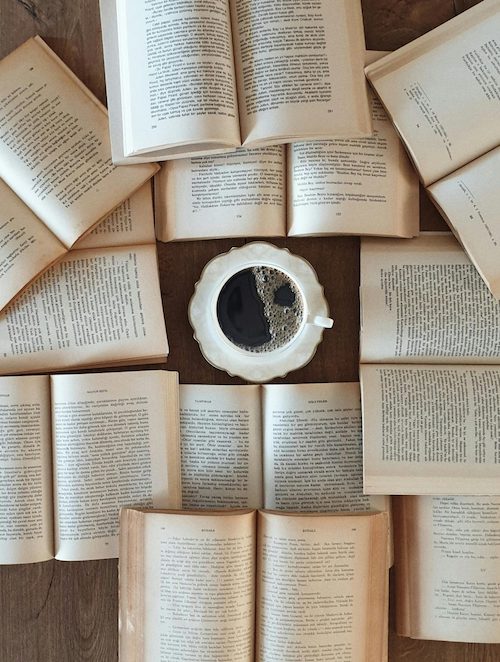
We the editorial staff of Spellbinder believe the writing we take in is just as important as the writing we produce. Whether focusing on texts within their own genre or taking inspiration from other parts of the literary world, many of the greatest writers we know are also great readers! Unsure what you should look at next? Here’s a recent reading list—take a look at what’s been keeping us spellbound!
Tatianna Kalb: Co-Editor In Chief
Max Porter – Grief is the Thing with Feathers, Faber & Faber 2015
Monologues, poetry, and a crow blend together in this novel to give a distorted look at the world of a family who is suspended in grief after losing their mother. Magical realism whispers through the pages, yet each snippet of daily life locks the reader into the cage of the characters’ emotions. Grief Is the Thing with Feathers is part monologue, part poem, part prose, and gives readers and writers alike a moving example of how different forms can come together to create work that has reality pouring out of every page. Published in 2015, it was a stunning example of what a debut novel can achieve.
Effy Kousteni: Co-Editor In Chief
Sarah Kane – Complete Plays (Blasted / Phaedra’s Love / Cleansed / Crave / 4.48 Psychosis / Skin)
This is not reading for comfort, catharsis, or reassurance. Sarah Kane’s plays refuse moral safety nets, confronting violence, desire, power, and despair head-on while making the reader feel implicated rather than entertained. Emerging from the 1990s British “in-yer-face” movement, Kane’s violence is never ironic or playful; it’s deadly serious, a surface symptom of deeper social and emotional collapse shaped by war, patriarchy, and abandonment. What is often overlooked is her obsession with love, not as redemption, but as an annihilating force: consuming, humiliating, and insufficient to save you. As her work progresses, Kane breaks form when realism fails her. Blasted collapses into war, Cleansed turns to ritualised violence, Crave dissolves into disembodied voices, and 4.48 Psychosis abandons character, setting, and instruction entirely. Moving towards the edge of language itself, Kane presents mental illness without metaphor or hope, insisting that theatre remain morally dangerous. Ironically, she is now canonical.
Sean Patrick Mulroy: Editor, Web
Mark Fisher – Ghosts Of My Life: Writings On Depression, Hauntology, And Lost Futures, Zero Books 2014
Perhaps most well-known for his controversial essay, Exiting the Vampire Castle (the backlash to which would eventually drive him to take his own life), Fisher’s cultural musings are consistently anti-capitalist in nature, and Ghosts of My Life is no exception. From the door-kicking take-down of capitalism’s effect on cultural innovation, “The Slow Cancellation of the Future,” to the detailed and contemplative film review, “The Lost Unconscious: Christopher Nolan’s Inception,” Ghosts of My Life shows why, despite his relatively brief life and career, Mark Fisher is considered one of the most influential critical and philosophical writers of the 21st century.
Emma Langmaid: Editor, Drama
Sally Rooney – Intermezzo
At the moment I’m not reading plays so much as watching television and film for showreel material. I am, however, reading the razor-sharp Intermezzo by Sally Rooney. I’m very late to cracking the spine on this one. I bought the hardback on its release date last year, thinking my enthusiasm for Rooney would trump my hatred of hardbacks. It didn’t. I regret not getting to it earlier though, because Intermezzo has captured me entirely. Rooney experiments with two distinct prose styles to reflect the disparate inner lives of two brothers. One, Peter. Rooney uses short sensory sentences that leave the reader feeling attacked, like literary whiplash, to reflect Peter’s hyper-aroused state. In contrast, every other chapter flows logically, analytically, and sometimes coldly, describing the world around autistic and aloof Ivan. Intermezzo is soulful and thrilling. My favourite sentence describes the experience of being neurodivergent with heartbreaking precision:
“How often in his life he has found himself a frustrated observer of apparently impenetrable systems, watching other people participate effortlessly in structures he can find no way to enter or even understand. So often that it’s practically base-line, just normal existence for him. And this is not only due to the irrational nature of other people, and the consequent irrationality of the rules and processes they devise; it’s due to Ivan himself, his fundamental unsuitedness to life. He knows this. He feels himself to have been formed, somehow, with something other than life in mind.”
Yuyi He: Editor, Non-Fiction
William James – The Varieties of Religious Experience
This book is a psychological exploration of human religiosity written by William James, the father of American psychology and key member of the philosophical movement of pragmatism. Rather than focusing on the external, societal aspects commonly described by religious studies, it is unique for shining a spotlight on religious or mystical experiences. Many of the chapters illuminate the relationship between these experiences and various psychological concepts, including emotions, mental well-being, and personality. Other chapters focus on topics such as religious conversion, the fruits of “saintlines”, and the broader philosophical implications of his book.
Zach Pedigo: Editor, Poetry
Philippe Besson (trans. Molly Ringwald) – Lie With Me
I’ve just finished Lie With Me and have not been able to stop thinking about it. Originally written in French, Besson’s book features two characters, Philippe and Thomas, unironically the author’s name and the name of the person to whom the book is dedicated. The characters Philippe and Thomas meet in school, where they do not interact, and start seeing each other in secret: an affair. The book is nearly 150 pages, making it the perfect length to develop a relationship with the characters, but being short enough that anybody can take the time to read it. This book is, simply put, gorgeous, beautiful, and I continue to think about it.
Conor Thew: Associate Editor, Drama
Maria J. Pérez Cuervo (editor) – Hellebore Magazine (Vol. 1 & 2) – The Sacrifice & The Wild Gods Issues
Written and edited by Maria J. Pérez Cuervo, with illustrations curated by Nathaniel Hébert, Hellebore is a small press, publishing non-fiction centered around folk horror, paganism, witchcraft and the occult, and their influence on national history, cinema, art and literature. The magazine also published The Hellebore Guide to Occult Britain, a travel guide for key historical sites of occult and pagan origin, and Tales of Occult Britain, a short story collection from contemporary writers, inspired by existing history and folklore.
Volume One: The Sacrifice Issue includes essays on bog bodies and the speculation around why they form, prehistoric monuments depicting ancient deities, and rumours of ritualistic sacrifice in rural communities. This is complemented by artwork depicting maenad-like creatures dancing around campfires, stone monoliths, and skulls, encouraging readers to speculate about the existence of these cults in remote or rural communities across Britain. This issue, along with Volume Two: The Wild Gods Issue, delves into Britain’s long fascination and enamourment with pagan religion and Hellenism; the second issue includes articles focusing on the Edwardian cult dedicated to the horned god Pan, and the work and origins of Satanism through Aleister Crowley. The magazine as a whole, particularly in the second issue, seems to uphold and celebrate paganism and witchcraft as a tool for rejecting gender roles, sexual taboo, and conventionalism, through magic and rediscovering our connection to the natural world and ancestral tradition.
Steph Carroll: Co-Editor, Fiction
Frieda McFadden – The Housemaid
This psychological thriller became a viral sensation over the last few years, and its film adaptation has recently become a box office hit. It is a wicked, indulgent, deceptive (in the best possible way) read that builds tension so well that it makes your skin crawl. The very definition of this book is that not everything is as it seems. There are many different branches to this story, but everything flows seamlessly to keep you on the edge of your seat throughout. Secrets unravel and lies fall apart in this shocking story, which is a refreshingly original addition to the genre.
Madison Walker: Associate Editor, Fiction
Sylvia Townsend Warner – Lolly Willowes
Lolly Willowes (or The Loving Huntsman) is Sylvia Townsend Warner’s first novella, published in 1926 and subsequently met with great critical and commercial success. Warner, renowned for her subversive wit and eccentric style, blends elements of fantasy with commentary on class and gender to conduct an observation on conservation in the countryside. The novella follows the titular character, Lolly, as she pursues the fantasy of being a self-sufficient woman in early twentieth-century Britain. She engages in witchcraft, devilish sabotage, and moonlight rituals on her journey to find solace in the countryside. Warner’s rural landscape is transgressive, empowering, and ultimately enchanting.
Rosa Butcher: Associate Editor, Fiction
Giuseppe Raimondi and Renato Bertacchini (editors) – Narratori di Emilia e di Romagna
Recently, feeling nostalgic for my old university city of Bologna, I picked up a book containing extracts of novels written by authors from the region: Emilia-Romagna. The anthology aims to paint a civic and historical picture of the region and its inhabitants, caught between the 19th and 20th centuries. The tone is set with the utmost sincerity, aimed at depicting the problems and conditions of the people, sometimes falling into the web of a tremulous and tragic elegy.
This is the case for the story I’ve just finished, Azurèn. It is a convincing description of a spring dusk in the countryside. I am familiar with the gentle care farmers of Emilia-Romagna put into their orchards and olive groves, and I can perfectly hear the birds mentioned by the author, Beltramelli. This familiarity makes the tragic ending feel more poignant. I was immersed there, among the orchards and blackbird sounds, when the youngest child of the group, Azurèn—who had always suffered from poor health—dies peacefully under the eyes of his confused friends while playing hide-and-seek. As night draws in, the confusion escalates to despair, mirroring the quick arrival of darkness in the fields. What struck me, aside from the tragedy, is the quiet depiction of the farmland and the freedom of village children, allowed to roam for hours on end through the surrounding fields. It was a beautiful surprise to come across these writers and discover temperaments and souls so deeply rooted in their territory. Without needing to modify and oversaturate the colours of their prose they remain loyal to the concrete happenings of their daily lives.
This blog post, along with many others, is also available to read on the Spellnotes section of our website.
If you don’t follow on social media yet, you can find links to all of our channels here.
You can also listen to our seasonal issue inspired playlists on our Spotify channel.
If you’d like to read more of Spellbinder’s work, you can subscribe here. Our magazine is available in both PDF and paperback formats. Click here to learn more.
Photo by z f on Pexels.