
In the midst of the third millennium’s chaos and apocalyptic predictions, the waitress serves my cappuccino and calls me ‘honey’. The café is small, peculiarly quaint: five tables and a slightly askew picture of the New York City skyline. The doorbell jingles and in walks the waitress’s partner, daffodils in hand and the certainty of a man who has rehearsed this moment. The three of us customers become unwilling extras. They hurry towards each other, aprons crumpling, flowers tilting dangerously. It’s cinematic, though not for the reasons they imagine. The detail is what sells it: the tilt of the bouquet to avoid jabbing her shoulder and the way her grin arrives a beat before the thank you.
But let us not spiral. Are we ironing out the creases or keeping them? Love rarely bursts through doors holding daffodils. It’s not a montage, but mismatched socks, missing remotes, low disputes over heating and the quiet resentment of toothpaste squeezed from the middle. Romantic comedies offer a script: meet-cutes, misunderstandings and a grand resolution. Watching this scene unfold in Peckham Rye, however, it becomes clear why romance writing so often fails: it reaches for spectacle and misses observation.
Love lives in attention to detail
The difference between a scene that feels written and one that feels lived in is detail. Not more of it, but the right kind. In Fleabag, intimacy is built through reaction shots: a glance held half a beat too long, a look that lands after the dialogue has finished.
Fleabag Episode 2.1 – Phoebe Waller-Bridge
EXT. BACK OF RESTAURANT – NIGHT 1
FLEABAG now has her forehead against the brick wall. She exhales cigarette smoke.
The PRIEST appears.
Nothing is explained. There’s no ‘she’s exhausted’ or ‘she’s overwhelmed.’ Just a physical position and a simple action, but it’s enough. We understand exactly where she is emotionally because we can see it—and so can the Priest.
Write action lines that capture behaviour, not emotion. Not ‘she feels nervous’, but ‘she straightens a spoon that does not need straightening’. Give actors something playable. Give the camera something to find. If the audience can see it, they will feel it.
Love is watching and remembering
Attention is not passive, it accumulates. In Normal People love is built through attention that gathers over time, never stated outright but carried in behaviour that repeats, shifts, and returns with new meaning. The chain Marianne gives Connell becomes significant not as a symbol in isolation, but because it reappears in a different emotional context, carrying the residue of what has already happened between them. The relationship feels real because it exists in continuity rather than declaration, where meaning is built through return rather than speech.
Plant details early and pay them off later. A preference, a habit, a throwaway line. Then bring it back in a different emotional context. Memory is structure. It shows the relationship has existed off the page.
Love is messy, and the mess is the point
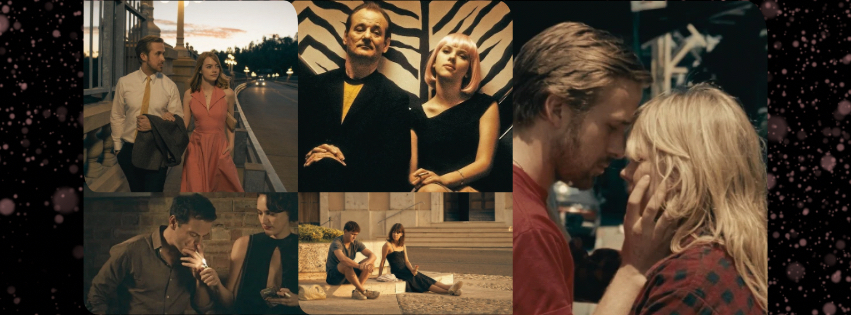
The problem with polished romance is that it feels like it has been tidied for company. Real relationships are rarely guest-ready. La La Land choreographs imperfection. The dance works because it nearly doesn’t. It builds intimacy through awkward timing, slight hesitations, characters speaking just a fraction out of sync.
La La Land – Damien Chazzele
SEBASTIAN
I know…
(beat)
I don’t know.
MIA
What do we do?
SEBASTIAN
I don’t think we can do anything. Because when you get this –
MIA
If I get this –
SEBASTIAN
When you get this – you’ve got to give it everything you’ve got.
Beat.
SEBASTIAN (CONT’D)
It’s your dream.
Write interruption into dialogue. Use unfinished lines, overlapping intention, and timing that doesn’t quite land cleanly. Allow the characters to physically adjust around each other: hesitate, re-enter, recover. Intimacy often comes from how people fail to move smoothly together, then try again.
Love is often quiet
Writers tend to overfill scenes, as if silence might expose them. It usually does the opposite. In Lost in Translation, entire scenes are constructed from shared stillness: characters observe rather than explain, sit together without obligation to perform, and allow moments to exist without resolution.
Lost in Translation – Sofia Coppola
INT. CHARLOTTE’S ROOM -NIGHT
He puts her on her bed. He takes her shoes off for her and pulls a blanket over her.
He looks at her lying on the bed.
She opens her eyes to smile at him. He wants to kiss her, but he leaves.
Write beats, not speeches. Use ‘a moment’, ‘they sit’, ‘he watches her’ as deliberate units of action. Trust the gap. If a line can be cut and the scene still works, cut it. Silence is not empty, it’s active.
Love is overthinking, but usefully
People analyse everything: texts, pauses, tone and punctuation. Exhausting in life, invaluable in writing. In Blue Valentine, conversations remain functional; about work, money, childcare, logistics, while the relationship deteriorates in what is not said. The words stay controlled, even ordinary, but the behaviour tells a different story: distance where there used to be closeness, avoidance where there used to be curiosity. Nothing is explicitly explained, yet everything is readable. The audience is forced into the role of interpreter, doing the emotional arithmetic between tone and action.
Let subtext do the heavy lifting. Write dialogue that says one thing and behaviour that suggests another. Let characters misread each other occasionally, then correct it through action, not explanation. Misunderstanding is not a failure of communication, but the point.
Love is ordinary and cinematic at the same time
The mistake is thinking these are opposites. They are not. Back in the café, the embrace is the obvious beat, but the intimacy is in the adjustments: the angle of the flowers, the shared glance, the micro-check that the other is all right.
Write the moments around the moment. Not just the kiss, but the second before it happens and the moment after, when something shifts. The expected beat is rarely the most interesting one. The surrounding beats are where the truth sits.
It becomes clear that in writing, the moment itself is not particularly rare. People arrive with flowers, hug, and say thank you. On paper, it’s unremarkable. What makes it cinematic is the precision of it. The half-second pause and the careful adjustment. This is where romance lives on the page as well. Not in the gesture, but in how the gesture is handled. Not in the declaration, but in the behaviour surrounding it. Writers often reach for scale, for something heightened, when the real work lies in observation, in choosing the right detail and then trusting it.
Effy Kousteni, Co-Editor-In-Chief
This blog post, along with many others, is available to read on the Spellnotes section of our website.
If you don’t follow us on social media yet, you can find links to all our channels here.
If you’d like to read or view this work in full, you can subscribe here. Our magazine is available in both PDF and paperback formats. Click here to learn more.