
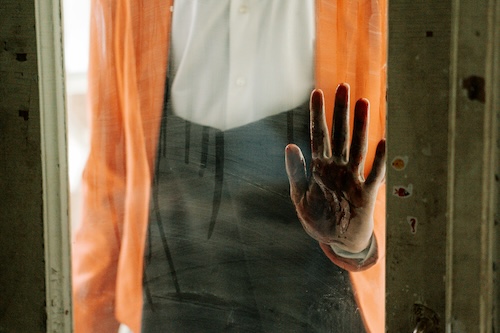
Popular murderess icons are a dime a dozen, and one such icon exemplified in Bryanna Licciardi’s The Polisher is ‘The Monstrous Homemaker,’ where weaponised domesticity transforms a comely figure of nurture into something lethal. Characters such as Pearl in Pearl are trademarked to rupture their simple, sweet shell of femininity and docility, like a boiling blister to inherit the sinister. The Polisher, however, is sanitised, calm, and the picture of pristine. She dresses in her Sunday best and takes her supplies-in-a-stroller out for a spin of murder-round-the-block. Bryanna Licciardi proves why the housewife makes the perfect murderer. The key to a good murder is, after all, only as good as the quality of its artist.
As a huge fan of flash-fiction, The Polisher is a fine demonstration of that form. It shows how the intent, intensity, and implication of the written details can decide whether a narrative will compel or collapse. It defines the ebb and flow of a scene: the voiced and unvoiced, flaw and strength. As the reader, you find the macabre workings happening right before you to be quite inescapable. You are compelled to question if the hard-bristled brush with the wooden knob handle is her favourite because of its comforting scratchy noise, or because of the associated act of getting onto her knees to really scrub the blood off. You might then be compelled to wonder why, instead of chasing the craze, “she needs this quiet calm after such an excitable time.” You wonder why there is a necessity. And that ‘why’ is the necessity.
The reader anticipates an epiphany that should come but never does. Inverted themes solidify the foundation of The Polisher, which continuously seeks to thwart expectations by suspending the drop. To deny the gratuity of shock and drama is intentional, in favour of stretching out the tension, repeatedly rolled back and forth between the mundane motions of vacuuming, scrubbing, and polishing. Perhaps it’s an exercise in restraint, given that “people are messy, displaced by dirty, living feelings,” in supplication to The Polisher’s need for calm. Or perhaps, it’s a ritualistic feeding, one in which “the perfect piece is complete not after the screams, not the confused pleas or the bubbling of blood from mouths, but after everything around her shines exactly in its righteous place.”
Instead of the disgruntled matriarch exhausted of her homely duties and ripping into suburban fantasy, or the scum of lower society cosplaying a role she would not know, The Polisher murders for creative expression, attempting in each bloodied home a “true” masterpiece. The implications of such a trope are bountiful: a violent outcry and revolt against all the women shut in their pretty, polished homes; a cruel, sharp commentary on the necessity of art and expression; or a lonely woman’s efforts to find a higher purpose beyond her mortal shell. In fact, when she ‘posed the corpses like angels, limbs spread up and out across the living room rug,’ she embodies all three roles of the avenger, the artist, and the maker — She is The Polisher.
What was meant to be the grand reveal just widened the chasm. That dissonance, the continuous questioning, is exactly the point. It should befuddle you that this woman greedily inhales citrus cleaner and bleach as she surveys the scene. She fills a stroller with supplies where her baby should have been– if there ever was a baby. It should befuddle you that she believes, “they need her to free them. And she loves to be needed.”
In a publishing and literary era where tropes have been inflated into aesthetic markers that define narrative quality, Bryanna Licciardi strips down the facade of the palatable and enchanting to reveal the decay of human nature. The Polisher is a sharp construction of flash fiction that unravels through its blank candor, rooting itself in the physicality of action, observation, and detail. It does not fail to stimulate the reader at every twist, and continuously forces them to question what other truths remain hidden and repressed. And though murder may not be the way, it is, after all, only human desire to leave your mark in someone’s life, even if they never realised you’ve sunk in the knife.
Ashlynn Zhang, Fiction Editor
This blog post, along with many others, is available to read on the Spellnotes section of our website.
If you don’t follow us on social media yet, you can find links to all our channels here.
If you’d like to read or view this work in full, you can subscribe here. Our magazine is available in both PDF and paperback formats. Click here to learn more.
Photo by Cottonbro Studio on Pexels.